
Every return a customer has asked for, newest first, 25 to a page. A return goes through two decisions, not one: you approve the request, they post the goods back, and only when it's in your hands do you refund it.
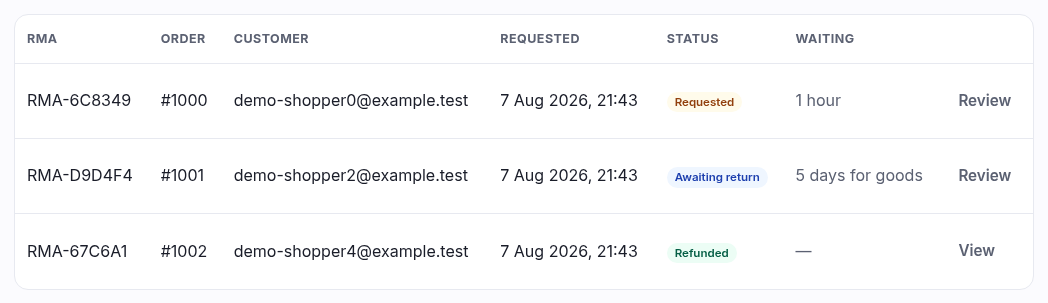
The three live states
| Badge | What it means | Whose move |
|---|---|---|
| Requested (amber) | They've asked. Nobody has decided, nothing has been sent, no money has moved. | Yours. |
| Awaiting return (blue) | You approved it and they've been emailed where to post it. Still no money. | Theirs — you're waiting on a parcel. |
| Refunded (green) | The goods came back and you refunded them. Done. | Nobody's. |
Two closed states finish the picture: Declined (you turned it down, either up front or after seeing the goods) and Cancelled (you approved it but nothing ever arrived).
The Waiting column
How long the return has sat where it is, and it means different things per state:
- On a Requested row it's how long the customer has been waiting on you. Anything measured in days here is a customer wondering if you read your email.
- On an Awaiting return row it reads "5 days for goods" — how long since you approved it. This is the number that tells you a parcel is never coming.
The action link is the same signal in words: Review while a return is live, View once it's finished.
Where returns come from
- A customer, from their account. They pick the order and the items and say why. That's what lands here as Requested.
- The till. A counter return is dealt with face to face and arrives here already refunded — a record for the books, never a job. The two-step flow doesn't apply, because the goods were on the counter the whole time.
What a customer is allowed to ask for
- Online orders only. Something bought at the till is returned at the till.
- One live return per order. While one is Requested or Awaiting return they can't open another, so you'll never get two half-requests for the same parcel.
- Only what hasn't already been refunded.
Who can work it
Seeing the queue needs permission to view orders. Every decision — approving, declining, refunding, cancelling — needs the refund permission, even the ones that move no money, because approving commits you to a refund later.