
Your rates decide what a card is worth in general. This screen is where you look at what that actually pays for a particular card, and overrule it where you disagree.

Reading a row
| Column | What it tells you |
|---|---|
| Market | The catalogue price in your currency. Everything else is worked out from this. |
| Pays now | What you would hand over today — or the reason you would not, such as Below your value limits or No rate set. |
| Target / Stock / Want | How many you will hold, how many you have, and the difference. |
| Incoming | Copies already on their way in on submitted lists, so you do not buy the same card twice over. |
| Remaining buys | Want less incoming. When this hits zero the card stops being offered. |
| Your cash / credit | Your own figure for this card, as a % of market or a fixed price. Leave blank to follow your rates. |
| Never buy card | Refuse it outright, in every condition. |
Languages
A card printed in more than one language you sell gets a language selector on its row. Switching it repaints that row with the figures for that language — its market price, its target, its stock — and anything you type is saved against that language alone. The Language box at the top of the screen sets which one every row opens on.
Only English has a catalogue price. Every other language is a share of it, which you set on Catalogue ▸ Buy & sell config. Without that share there is no sum to do, and the row will say so rather than quote you an English price for a foreign card.
Change rates
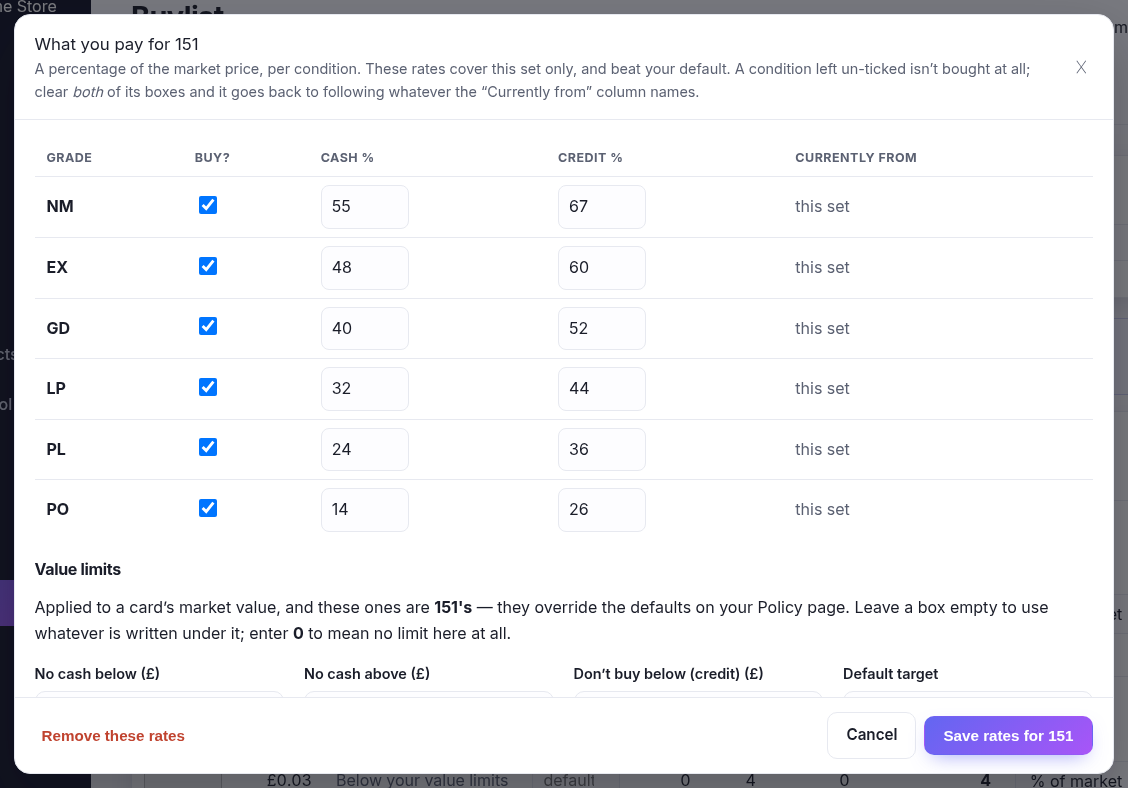
The ⚙ Change rates button sets what this game or set pays, without leaving the screen. Each non-English language can have a ladder of its own underneath the main one — leave a row empty and that language follows the rates above it, applied to its own market price.
Value limits sit below the ladders and can also differ per language: a smaller floor for a language you find harder to shift, or a lower target because you want fewer of them.
Which figure wins
Most specific first, and it is worth knowing the order:
- A price you typed on this card
- A rule for this card's rarity, then its type, then its language
- The rates for this set, then this game, then your default
Other grades opens the rest of the conditions for a card when you want to price them apart, rather than letting them follow the ladder.